|
|
Shopping List:
- Clear Glass Tiles
- Small Aanraku Bails
- Glamour Glaze
- Glamour Glue (optional)
- 1 Tube of E6000 Adhesive
- Burnisher
- Decorative Papers
You Will Also Need:
- X-acto or similar blade, or craft scissors
- moist paper towels |
| |
|
|
 |
|
Step 1:
Be sure your hands are free of any lotion or oils. Rinse the glass in room temperature water to remove any dust. Dry using a lint free cloth. If necessary, wipe the glass with rubbing alcohol to remove lotions or oils. |
| |
|
|
 |
|
Step 2:
Inspect the glass tile. One side of
the tile is smooth and the other side has a little bit of texture. You will want to adhere the paper to the textured side of the glass. |
| |
|
|
 |
|
Step 3:
Select untrimmed decorative paper you’d like to use. Set aside. Take your clean glass tile, texture side up, and apply a coating of Glamour Glaze. You want just enough to fill in the texture of the glass, so don’t skimp. Working quickly (Glamour Glaze dries fairly quickly) place the tile Glamour Glaze side down on the patterned side of your decorative paper. You will want to be able to see through the glass to the patterned paper. |
| |
|
|


|
|
Step 4:
Press the glass down firmly onto the paper with your thumb using a table top as a flat surface. When using the circle glass, the paper should arrive to you already trimmed, so try to center the glass on the paper. Use even, strong pressure. This removes any air bubbles in the Glamour Glaze. You will see some excess Glamour Glaze ooze from the edge of the glass. This is good. Just wipe it off.
Allow the Glamour Glaze to dry. This normally takes about 30 minutes. I like to dry them first glass-side-up, then flip them over once everything is set so the paper is up and exposed to the air. I like
to think it dries faster with
the paper side up.
|
| |
|
|


|
|
Step 5:
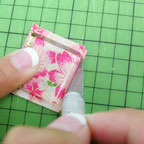
For the Square Tiles, using a fresh, sharp X-acto blade (I use a #11 blade), put the glass tile paper-side down onto a cutting surface, such as a self-healing mat. Carefully trim the excess paper from the edges while pressing firmly down on the glass tile. I find if I use light pressure on my first cut and then slightly heavier pressure on the second cut I can get a nice clean cut. I also hold my blade at a slight angle (inward) so the cut is just inside the edge of the glass tile.
Should the round wafers need trimming, I find a pair of clean cuticle scissors works well to snip off any excess. Alternatively, you may also opt to use the X-acto blade using the same method indicated for the square tiles.
Scrape the edges carefully with the edge of the blade to remove any excess Glamour Glaze.
|
| |
|
|
 |
|
Step 6:
Apply a coat of Glamour Glaze to the back side of the pendant. Chances are good this is plain white. You just want an even coat preferably without bubbles, but this is the backside and not visible when worn. Alternatively, you may wish to use a second, thicker paper, fabric, or even wood veneer to cover the backside since any water based glaze will get sticky with poisture and heat. If you choose to use a spray varnish, select a non-yellowing variety (Krylon makes one.)
|
| |
|
|


|
|
Step 7:
Attach the Bail (or magnet) Once the Glamour Glaze has dried on the back, you’re now ready to attach the bail. Using the E-6000 adhesive and a toothpick, apply a small amount to the bail where the small reservoir is located. Then press the bail firmly to the paper side of the pendant (the part you just coated with Glamour Glaze). Center the bail and let dry about 12 hours.
If you find the bail isn’t centered or has shifted, no problem. You can remove the bail gently using firm pressure, clean the adhesive off with your fingers, and reapply until you have it just right. Be very careful not to
separate the paper from the glass.
|
| |
|
|
 |
|
CONGRATULATIONS!
You have just made a beautiful Glass Pendant!
For more fun kits, please visit me at www.anniehowes.com
|
| |
|
|
| |
|
Notes:
If you have purchased one of the Piddix Kits, pleae email me with the Volume you purchased and I will send the Digital Collage sheet and the photo tutorial to you.
If you are using inkjet prints, let your prints dry for about 2 weeks. The longer they dry the more stable the ink becomes. I have a separate tutorial for Photo Pendants which I email to customers who purchase one of my Piddix Kits
|
This product and all the
instructions and photographs
contained in this kit are
copyright protected. Any
reproduction or duplication
of the instructions or kit in any
form is in violation of all
copyright laws.
© 2008-2010 Annie Howes |